The Order
Across the River and into the TreesThe Order is a discreet brotherhood whose small number of revealed practices combine military fellowship, ceremonial rank, and guarded knowledge. Its membership is connected to war service, its Gran Maestro exercises authority over admission, and Richard Cantwell is entrusted with revealing its Supreme Secret. The organization’s most consequential disclosure is not a rule of combat or a public creed, but the observation that death can make even love and pleasure fall silent.
Identity and Authority
The available account presents The Order through its dealings among a few people rather than through a full charter or history. Its leader is the Gran Maestro, whose approval matters when Richard Cantwell proposes that a young woman may be suitable for membership. Cantwell says he will take the question up with the Gran Maestro, establishing a line of authority without explaining how the organization is structured beyond that relationship.
The Order is known to people beyond its members. A woman tells Cantwell that she knows about it, while clarifying that she does not belong to it. That distinction matters: knowledge of the group is not the same as admission, and its existence is not treated as wholly secret. The exchange gives the organization an informal, personal quality. Membership is discussed in conversation, but the decision remains with its leader.
Leadership and Circumstances
The Gran Maestro’s authority appears again when Cantwell asks whether there is news from The Order. The report concerns the leader himself: everything he owns has been confiscated, or, as the speaker qualifies it, has at least been subject to intervention. The wording leaves the exact legal circumstance uncertain, and Cantwell responds by hoping it is not serious. The organization is therefore introduced not as insulated from worldly pressure, but as connected to a leader facing an external intervention whose severity is unclear.
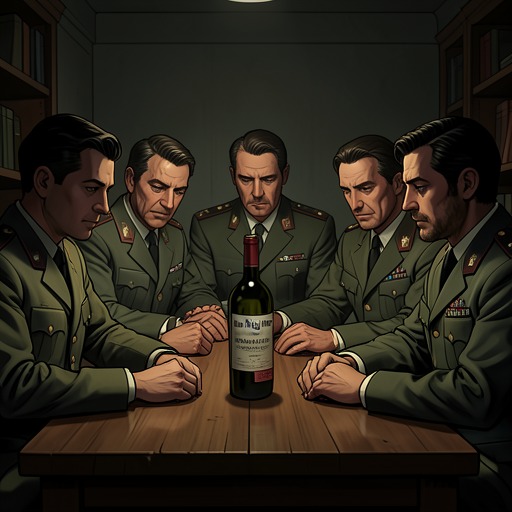
That news is followed by an act of convivial ceremony. The Gran Maestro raises a glass of newly decanted Valpolicella and calls on the young woman to drink to the leader. She refuses to drink to him, calling him a swine, and adds that she does not belong to The Order. The Gran Maestro answers that she is now a member, admitting her for merit in war. Her initial refusal and immediate change of status make the scene’s humor depend on a real institutional act: the leader’s declaration supersedes her assumption that she remains outside.
Membership and Recognition
The Gran Maestro’s admission is explicit, but its paperwork is not yet complete. He says the woman has not received her parchment and appoints her Super Honorary Secretary. The title grants her a conspicuous place in the group even before she possesses its formal document. The exchange thus distinguishes recognition from its written confirmation: she is told she belongs now, while the expected parchment remains pending.
Her admission is credited to war merit, not to a stated family connection or a prior initiation. The phrase makes service the grounds for inclusion, while the honorary office gives that inclusion a ceremonial shape. The scene does not detail her military actions or define the duties of the secretary; it establishes only the stated basis of membership and the title conferred. She says she is proud and happy to join, even as she observes that the Order is rough. Her response holds admiration and reservation together rather than presenting membership as unqualified comfort.
The Supreme Secret
The new member is told that Richard Cantwell will reveal the secrets of The Order. Before doing so, Cantwell checks whether anyone else is present; the Gran Maestro says that the other person is out with Miss Baedeker. Cantwell then announces that there is one major secret, asks the Gran Maestro to correct him if he errs, and receives permission to proceed. The sequence turns revelation into a small, formal performance, complete with an audience check and an invitation to correct the speaker.
Cantwell gives the secret in a sentence that joins pleasure to mortality: “Love is love and fun is fun. But it is always so quiet when the gold fish die.” The Gran Maestro confirms that it has been revealed. The secret offers no practical instruction; its force comes from the contrast between the lively persistence of love and fun and the quietness associated with death. In the context of a membership awarded for war merit, that intimate image gives The Order’s guarded knowledge a grave undertone without explaining it away as doctrine.
The organization’s identity is consequently conveyed through what its members do together: consult the Gran Maestro, recognize service, confer an office, raise a glass, and pass on a secret. The scene’s joking ceremony and the secret’s stillness coexist. Renata’s pride in joining, qualified by her sense that the Order is rough, preserves that tension rather than resolving it.